This post previews the upcoming runoffs for the Georgia primaries. The initial races were held on May 24, while the runoffs are taking place four weeks later on June 21. Previously, runoffs occurred six weeks after the regular election, but a new law shortened the time frame. This is primarily due to the fact that runoffs for the November general election occurred in January, after the start of new Congressional terms. Notably, David Perdue's seat was technically vacant by the time he lost a runoff to Jon Ossoff in 2021.
State Overview
 |
| Map of Georgia (Public domain; Courtesy of the UT Map Collection via Wikimedia Commons) |
The state of Georgia is located in the southeastern part of the United States. Its capital is Atlanta, whose metropolitan area makes up around 60% of the state's population of 10.5 million. Georgia, like much of the South, was historically solidly Democratic until the late twentieth century. Beginning in the 1990s, the state shifted to Republicans. Republicans have held power in the state for two decades now. Growth in Metro Atlanta began to increase Democratic strength in the 2010s, and President Joe Biden (D-DE) pulled off a narrow victory in the 2020 election. That election was marred by former President Donald Trump (R-NY/FL)'s false accusations of voter fraud. Simultaneously, Democrats flipped both of the state's U.S. Senate seats, electing Senators Jon Ossoff (D-Atlanta) and Raphael Warnock (D-Atlanta). Georgia is now one of the country's premier swing states, and both parties expect competitive races this fall for Governor and U.S. Senate.
The races for most Congressional and statewide offices were decided by the initial primaries. Two Democratic and four Republican runoffs are occurring for U.S. House. Democrats meanwhile have four runoffs in statewide row offices. Several state legislative races are also on the ballot. I focus on Congressional and statewide races in this preview but include a list of legislative runoffs as well.
Congressional Races
 |
| New Georgia Congressional districts (Courtesy Georgia General Assembly) |
District 1
District Overview: District 1 is located along the coastal region of the state. Major cities include Savannah, Brunswick, and Waycross. This district is mostly rural and Republican. Redistricting only added a point to Donald Trump's 2020 margin here, bringing it to Trump +13. It is highly unlikely to be competitive in the fall, as incumbent Buddy Carter (R-Pooler) won reelection with 58.4% of the vote in 2020. A Democratic runoff will determine his challenger.
Democratic Runoff
Businesswoman and veteran
Joyce Griggs placed first in May, with 48.6% of the vote. Griggs previously ran in 2020, garnering 41.7% of the vote against Carter. She is running on a fairly standard Democratic platform emphasizing healthcare, the environment, and criminal justice reform. Griggs falls within the conservative wing of the party, having received the
endorsement of Democrats for Life. Attorney
Wade Herring is challenging Griggs. Herring is also running on a standard Democratic platform, though he appears to be more liberal than Griggs. His platform includes planks responding to the leaked
Roe v. Wade decision and recent mass shootings. Herring's environmental agenda also highlights the importance of climate change to this coastal district in a way Griggs does not. He received the
endorsements of two current state representatives, former Savannah mayor Otis Johnson, and the AFL-CIO.
The race has been fairly quiet, though Griggs has come under fire for her
disbarment in the early 2000s. She has cited racism and sexism as motivating factors for the disbarment, along with alleging retaliation by Republicans upset over a congressional campaign against former Congressman Jack Kingston. Griggs may also garner sympathy from a
recent accident involving her campaign bus, though no injuries occurred. Herring has significantly outpaced Griggs in fundraising, though Griggs's name recognition from 2020 should not be discounted. It appears likely that either candidate can win.
District 2
District Overview: District 2 covers the southwestern portion of the state. Columbus and Macon are the two major cities, both located on the northern edge of the district. It is best known outside of Georgia for being the home of former President Jimmy Carter (D-Plains). The district is a rural VRA-protected majority-Black district, and Democrats have generally been successful here (Biden +10.5). Redistricting added some red areas to the district, and Republicans now see it as a long-shot opportunity. Incumbent Sanford Bishop (D-Albany) won 59.1% of the vote in 2020, so most prognosticators still view the long-time incumbent as favored to win in November. A Republican runoff will determine his opponent.
Republican Runoff
Veteran
Jeremy Hunt (not the British one) placed first in May, with 37% of the primary vote. Hunt is running as conservative Republican though not necessarily Trumpy. His platform emphasizes standard issues such as the right to life and the 2nd Amendment while also acknowledging the rural nature of the district. Hunt has played up his identity as both a veteran and a conservative African American, receiving endorsements from U.S. Senators Tom Cotton (R-AR) and Josh Hawley (R-MO) as well as former Secretary of State Mike Pompeo (R-KS). Attorney
Chris West placed second with 30.1% of the vote. His website offers little in the way of policy positions, though a large picture of West and former President Trump is displayed. At a
recent debate, West distinguished himself from Hunt by noting that Hunt lived in Connecticut as recently as earlier this year. Hunt, however, called West's allegation a lie and stressed his family's deep roots in the state.
The largest controversy in this race emerged in the past week. Former Trump administration official Wayne Johnson, who placed third,
sued Hunt and Fox News (along with host Brian Kilmeade) alleging improper collusion. The
complaint alleges that the network violated equal time rules by preferring Hunt over his opponents and allowing him to spread misinformation about his personal background. Johnson's attorneys label Hunt's misrepresentations as mail fraud and wire fraud, ultimately alleging the collaboration between the three defendants constitutes a RICO violation. Whether this case goes forward remains to be seen. If West can exploit these accusations, he may have an opening, but Hunt is certainly favored in the runoff given his significant fundraising and publicity edges.
District 6
District Overview: Unlike Districts 1 and 2, District 6 changed dramatically in redistricting. Republicans gerrymandered the seat away from a suburban metro Atlanta seat which gave Biden an 11-point margin to an exurban one which gave Trump a 15-point margin. Major cities include Cumming (don't laugh, you're not 12) and Dawsonville (home of NASCAR driver Bill Elliott). Incumbent Lucy McBath (D-Marietta) opted to run instead for District 7, leaving this seat open. Democrats nominated veteran Bob Christian to replace her. A Republican runoff will determine his opponent.
Republican Runoff
Physician
Rich McCormick placed first in May, garnering 43.1% of the vote. McCormick ran in 2020 for the 7th district, which included part of this district at the time. He narrowly lost to Carolyn Bourdeaux (D-Suwanee) in a race considered one of the nation's most competitive. McCormick's platform is fairly conservative, alleging Joe Biden is a socialist and alluding to Trumpy priorities such as constructing a wall along the U.S.-Mexico border. He also includes other culture war issues such as opposing mask mandates in schools and the right to life. Former chairman of the Georgia Ethics Commission
Jake Evans placed second with 23% of the vote. Evans is running on a staunchly right-wing platform and has received former President Trump's endorsement. His platform is explicitly "America First" and makes overtures to the "Big Lie" (Trump's false claim he won the 2020 election) specifically mentioning Pennsylvania's presidential election.
This race is highly competitive, with both candidates airing television advertisements on local stations. Both have also raised well over $1 million. At a
recent debate, McCormick hit Evans over his prior support for criminal justice reform and support for an exception to abortion restrictions based on the life of the mother. Evans responded by criticizing McCormick's out-of-state fundraising. Though McCormick ran well ahead of Evans in May, Evans's embrace of Trump may ultimately enable him to overcome that deficit. Whomever wins will be a strong favorite in this now-red seat.
District 7
District Overview: District 7 was also changed significantly in redistricting. In 2020, the 7th was one of the most competitive of the country encompassing a left-trending area on the edge of metro Atlanta. The new 7th was drawn as a Democratic vote sink (Biden +26.1) centered on Gwinnett County northeast of Atlanta. Two Democratic incumbents, Carolyn Bourdeaux (D-Suwannee) and Lucy McBath (D-Marietta), faced off in the primary, with McBath winning handily. A Republican runoff will determine her opponent.
Republican Runoff
Telecommunications salesman
Michael Corbin placed first in May with 41.1%. Corbin is emphasizing his status as a political newcomer. His platform contains standard conservative planks such as energy independence and border security. Imposing term limits on Congress is another key proposal of Corbin's. Businessman
Mark Gonsalves placed second, garnering 27.5% of the vote. Gonsalves's platform is also fairly standard for Republicans, though he places more emphasis on culture war issues such as Critical Race Theory and mask mandates.
Compared to the runoff in the 6th district, this race has largely gone under the radar. Gonsalves has significantly outraised Corbin, who frankly would be considered Some Dude-level if not for placing first. He also received endorsements from other candidates eliminated in May. Gonsalves is probably favored here over Corbin.
District 10
District Overview: The tenth district is staunchly red area of north central Georgia. The district is mainly rural but also includes some southern suburbs of Atlanta. Major cities include Athens and Madison. Redistricting made the district slightly redder, with Trump's margin increasing by three points to 23.7. Incumbent Jody Hice (R-Greensboro) opted to run instead for Secretary of State with Trump's backing but lost to incumbent Brad Raffensperger (R-Johns Creek). Both parties saw competitive primaries for this open seat, and runoffs are occurring in both races.
Republican Runoff
Trucking executive
Mike Collins placed first with 25.6% of the vote. Collins is the son of the late Mac Collins, who represented much of this area in Congress during the 1990s and early 2000s. His platform combines conservative planks such as fiscal responsibility with culture war issues such as CRT. Collins also includes Trump slogans such as "America First" and "Drain the Swamp" on his website. Former state representative
Vernon Jones came in second with 21.5%. Jones is a long-time Democrat from DeKalb County (a suburb of Atlanta), but, in 2020, he suddenly shifted hard-right and endorsed President Trump's failed reelection bid. Trump rewarded him, first with support in the governor's race against Brian Kemp, and then an endorsement when Jones switched to the 10th district following David Perdue's entry into the governor's race. Trump's endorsement appears to be the most significant difference between him and Collins, as Jones otherwise touts typical Republican priorities.
This race initially appeared highly competitive, but Collins appears to have the momentum going into the runoff. He recently received Governor Brian Kemp's
endorsement. (Kemp lives in Athens in this district). Collins recently made a
controversial tweet referencing a rape allegation against Jones. Jones filed a
complaint with local law enforcement who determined that no laws had been broken. Collins has also hit Jones over his prior career as a Democratic state legislator, noting his opposition to abortion restrictions in a
recent debate. While Jones's Trump endorsement should not be counted out, Collins appears poised to become the Republican nominee.
Democratic Runoff
Nurse
Tabitha Johnson-Green came first in the May primary, with 42% of the vote. Johnson-Green previously ran as the Democratic nominee in both 2018 and 2020, winning 37% of the general election vote in both years. Her platform is fairly progressive, including support for both Medicare for All and free college tuition. Victims' advocate
Jessica Fore placed second with 19.2% of the vote. A recount did occur between Fore and the third-place candidate, but Fore remained in second after the recount concluded. Like Johnson-Green, Fore's platform is a progressive one. At a recent forum held by the Oconee County Democratic Party, she emphasized her climate change activism and women's right to bodily autonomy. (Johnson-Green did not attend the forum).
Both candidates are relatively equal in fundraising, but Fore's campaign has been more active throughout the district. The recent recount, the largest story in this race, likely raised her name recognition as well. Still, a twenty-point gap is large to overcome. Either candidate could win in a race that has gotten far less attention than the Republican side.
State Races
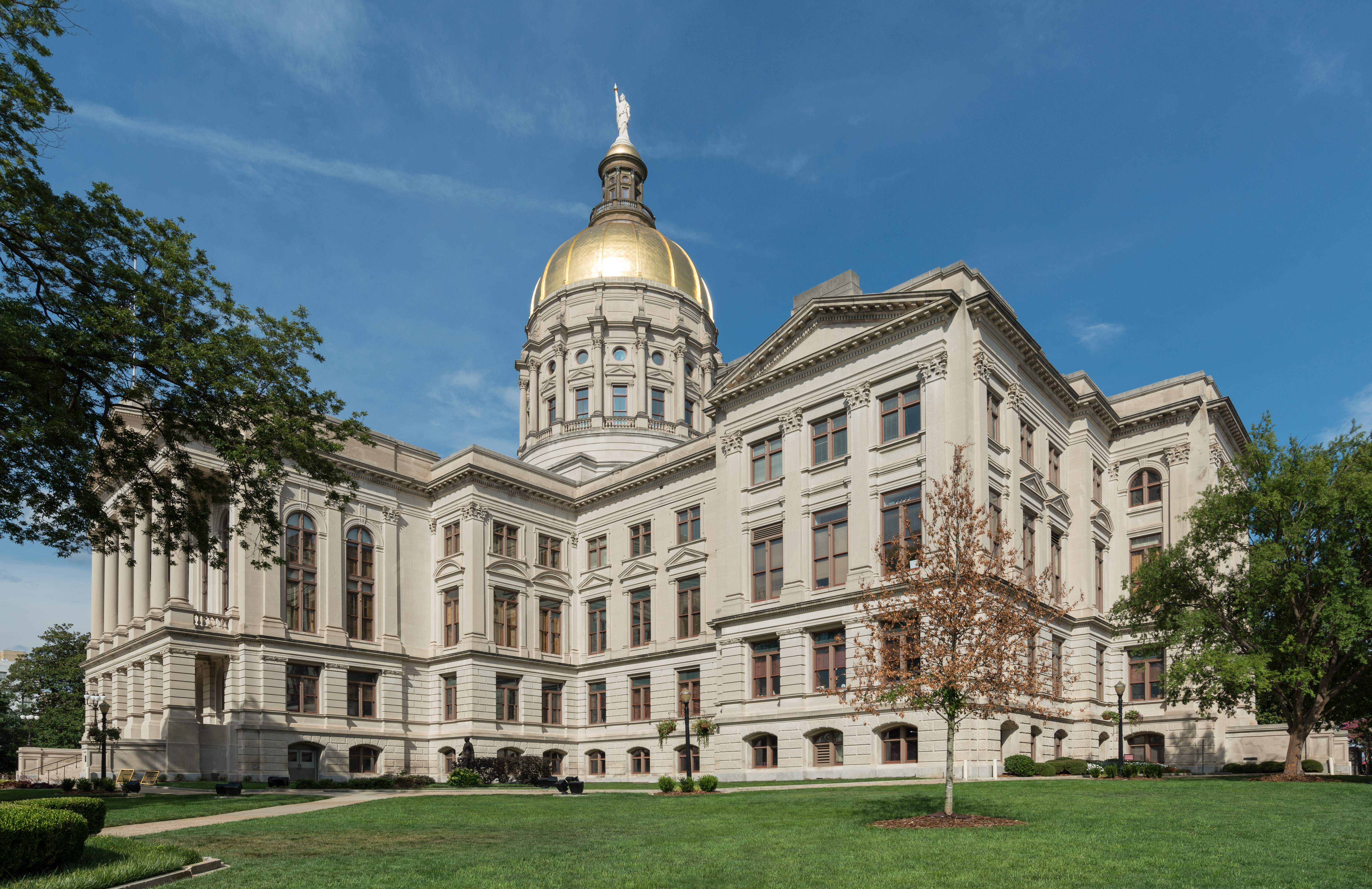 |
| Georgia State Capitol (Courtesy Wikimedia Commons) |
Row Offices
In addition to federal races, Georgia is also holding elections this year for its state-level offices. The state's governor's race is one of the nation's highest-profile, as Brian Kemp (R-Athens) fended off a primary challenge from former U.S. Senator David Perdue (R-Sea Island). Kemp's win set up a rematch with 2018 Democratic nominee Stacey Abrams (D-Atlanta), who has become nationally famous. Republican races for Georgia's row offices were also set in May, but four row offices have Democratic runoffs.
Lieutenant Governor
Former Congressman
Kwanza Hall placed first in May, with 30.2% of the vote. Hall has leaned heavily on his link to the late Rep. John Lewis (D-Atlanta), whom Hall succeeded in Congress. The centerpiece of his campaign is his "Prosperity for All" plan, which he touted at a recent forum held by the Oconee County Democratic Party. Hall did not elaborate on this plan, and his website unfortunately does not offer any details. Former prosecutor
Charlie Bailey placed second, garnering 17.6% of the vote. Like Hall, Bailey's website offers little in the way of policy positions. At the Oconee forum, however, the candidate offered four main proposals: support for Medicaid expansion, free tuitions at technical schools, progressive tax reforms, and increased broadband access.
The recent trajectory of this race has put Bailey in the driver's seat. Earlier this month, he received the endorsement of gubernatorial nominee Stacey Abrams. Hall's campaign has also suffered from the candidate's lower profile. He
missed the scheduled debate against Bailey, and reporters also
expressed frustration over his failure to respond to inquiries. Thus, Bailey appears to be the favorite heading in to the runoff.
Secretary of State
State representative
Bee Nguyen garnered 44.3% of the vote in May, placing first. Nguyen's platform is heavily focused on voting rights given that elections are the Secretary of State's most well-known responsibility. At the aforementioned Oconee County forum, she touted her work in the legislature opposing Republicans' recent changes to electoral laws, most notably SB 202. Nguyen also expressed support for a paper-ballot system. Former state representative
Dee Dawkins-Haigler placed second with 18.7% of the vote. She previously ran for SOS in 2018 but lost the primary to former Congressman John Barrow. Like Nguyen, Dawkins-Haigler emphasizes voting rights in her platform. She also stresses the Secretary's other responsibilities such as professional licensing and assistance to small business.
Nguyen was already a favorite going into the May primary, and the trajectory of the race has proven similar since then. Stacey Abrams recently endorsed her, further boosting her campaign. (Not to be out done, Dawkins-Haigler was
nominated for the Nobel Peace Prize. Yes, seriously.) The recent debate
focused on voting rights, offering little differences between the two. Nguyen is virtually certain to (ahem) win the runoff.
Insurance Commissioner
Insurance saleswoman
Janice Laws Robinson was just barely forced into the runoff, with 48.7% of the vote in May. Robinson previously ran in 2018 as the Democratic nominee, getting 47% of the vote. Robinson's platform emphasizes reducing insurance rates and clamping down on insurance fraud. Insurance agent
Raphael Baker placed second with 33% of the vote, in something of an upset over state representative Matthew Wilson. Like Robinson, Baker stresses the need to lower auto insurance rates, particularly for African American Georgians. His platform also addresses issues with health insurance.
In this low-profile race, the most notable event has been the recent runoff debate. Baker
failed to appear for that debate. Robinson has also significantly outraised Baker. Thus, it is hard to see a path to victory for Baker at this moment in time.
Labor Commissioner
State representative
Will Boddie placed first with 27.7% of the vote. Boddie has criticized the Republican incumbent for his handling of COVID-19, as state career centers remained close long after other government offices reopened. He also wants to increase the number of those career centers. Businesswoman
Nicole Horn came in second place, garnering 25.1% of the vote. Horn's platform addresses many of the same issues as Boddie, such as the lack of available career centers and customer service complaints. She appears to be slightly more progressive, strongly emphasizing her connections to labor unions.
The
recent debate offered little to distinguish the two from each other. Boddie's emphasis on his legislative experience provided the most concrete difference. He made a bigger splash earlier this month with an endorsement from Stacey Abrams. It would not be surprising at all to see Boddie prevail in the runoff on the basis of that endorsement alone, given the very low profile of this race.
Legislative Races
State legislative runoffs are also occurring. Recent redistricting made both chambers solidly Republican in contrast to the increasing competitiveness of the state House in the past few cycles. I will not go into much detail here but simply provide a short list. (The candidates are listed in the order in which they placed in the primary).
- SD-3 (R) - This district is located in southeastern Georgia. Banker Mike Hodges placed first and faces former state representative Jeff Jones.
- HD-24 (R) - This district is located in western Forsyth County, a northern suburb of metro Atlanta. Incumbent Sherri Gilligan was very narrowly forced into a runoff by businessman Carter Barrett due to a third candidate. This situation appears to be most likely due to Gilligan's far-right stances and criticisms of House Speaker David Ralston (R-Blue Ridge).
- HD-28 (R) - This district is located in eastern Forsyth County but includes part of neighboring Hall County. Businessman Brent Cox faces realtor Julie Tressler.
- HD-30 (R) - The district centers on Hall County on the northeastern edge of metro Atlanta, with a small portion of Gwinnett County. Businessman Derrick McCollum was very narrowly forced into a runoff with speech pathologist Whitney Pimentel.
- HD-39 (D) - This district is in Cobb County in the northern Atlanta metro. Schoolworker Monica DeLancey and attorney Terry Cummings are facing each other in the runoff.
- HD-50 (R) - This district centers on Johns Creek in northern Fulton County. Republican activist Betsy Kramer faces businessman Narender Reddy.
- HD-61 (D) - This district is in west central Fulton County and extends into neighboring Douglas County. Incumbent Roger Bruce faces charter school director Rashaun Kemp. Voters here recently received homophobic robotexts targeting Kemp (no relation to the Governor). Bruce's campaign has not responded to the incident.
- HD-86 (D) - This district is located in central DeKalb County. PhD candidate Imani Barnes is running against Jacqueline Adams.
- HD-90 (D) - This district covers the southwestern corner of DeKalb County. Former Georgia Democratic Party employee Saira Draper is running against psychologist Michelle Schreiner.
- HD-117 (R) - This district centers on Locust Grove in southern Henry County and includes a portion of Spalding County as well. Marketing professional Lauren Daniel faces non-profit executive Noelle Kahaian.
- HD-179 (R) - This district is located in Glynn County on Georgia's coast. Two businessmen, Rick Townsend and Bob Duncan, are facing each other.


